

A redirect sends the visitor’s browser to another page when a recipe runs: a thank-you page after a form submission, a resources page after a button click, a course page after a purchase. In Uncanny Automator 8.0 a redirect is an action, Redirect to a URL, from the built-in Redirect integration. This article shows how to add it, when a redirect cannot fire, and the cases it is used for.
The Redirect integration is part of the free plugin and is always available: it needs no other plugin and no connection.
What changed in 8.0
Earlier versions had a Redirect when all triggers are completed checkbox under the actions. It is gone in 8.0. The redirect is now an action you place in the flow like any other, which means you can see it on the canvas, switch it off, duplicate it, and put it inside a Filter block so it only fires when conditions are met. Recipes that used the old checkbox are converted when the site updates to 8.0: the checkbox becomes a Redirect to a URL action at the end of the recipe with the same URL.
Add a redirect to a recipe
- Open the recipe at Automator > Recipes and click the + at the end of the actions. In an empty recipe, click Add action.
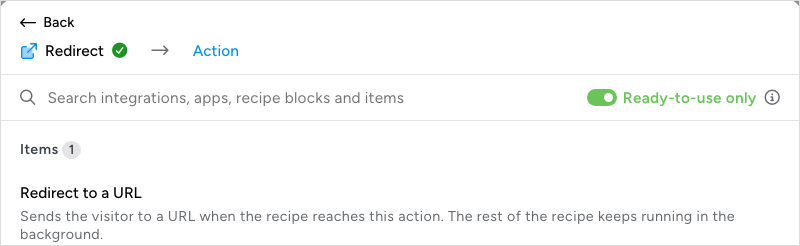
- In the picker, type Redirect in the search box, or expand All integrations and choose Redirect.
- Select Redirect to a URL, the integration’s only action. Its description reads “Sends the visitor to a URL when the recipe reaches this action. The rest of the recipe keeps running in the background.”
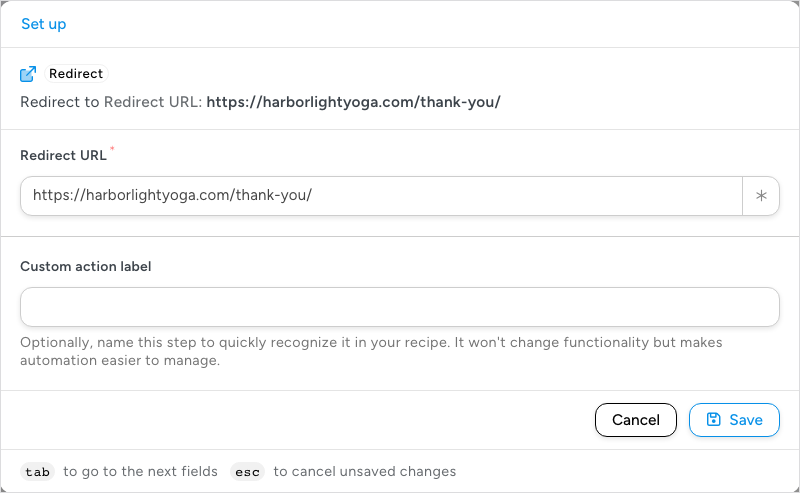
- In Set up, enter the destination in Redirect URL. It must be a full URL starting with
https://orhttp://, even for a page on your own site: enterhttps://example.com/thank-you/, not/thank-you/. A path without the domain is refused when you save, and the builder’s message reads “Redirect URL” must be a full URL that starts with https://, such as https://example.com/page/. The field supports tokens: click the ∗ button at the end of the field to insert, for example, the URL of the course the user has enrolled in. If a token does not produce a full URL when the recipe runs, the action fails with the log message “The redirect URL is not a valid HTTP or HTTPS URL.” - Click Save. This action has no Test step.
- A new action is added at the end of the flow, which is where the redirect belongs. If you added it inside a path or before other actions, drag it to the end. Make sure the action shows On and the recipe is switched to Recipe on.
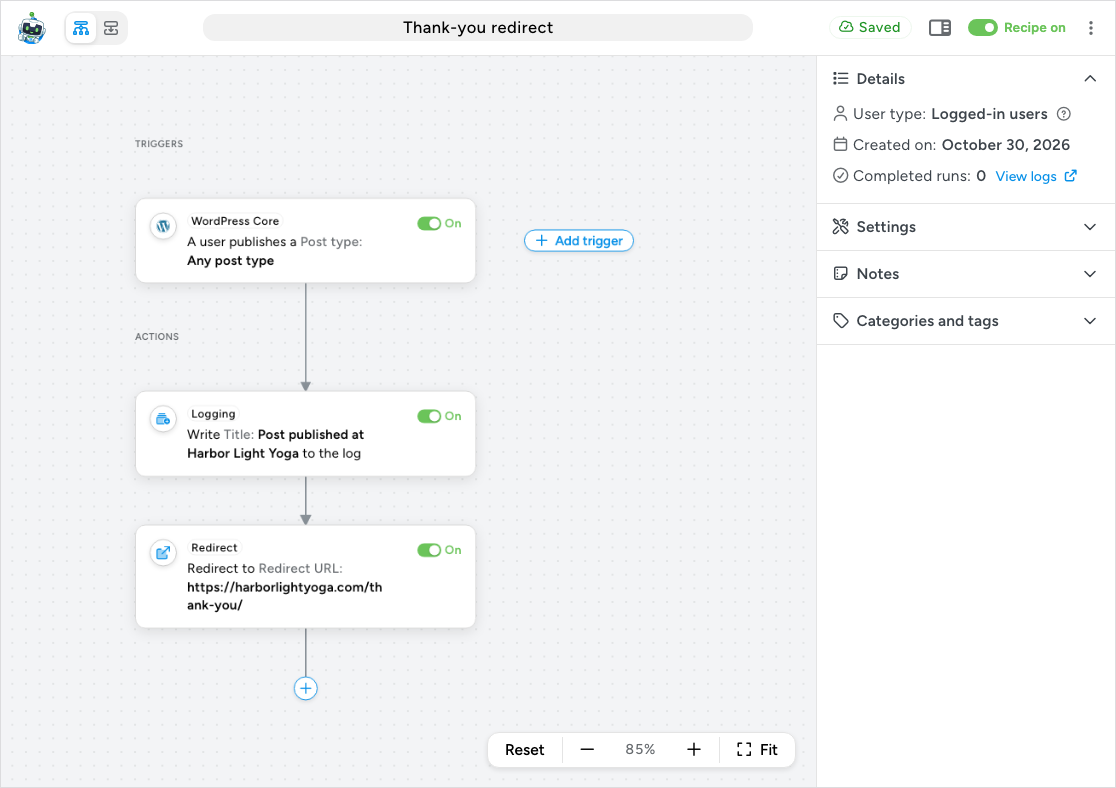
Put the redirect last. The visitor is sent to the URL when the recipe reaches the action, and any actions after it finish in the background, so the visitor never sees their result on the page they were on. A redirect inside a Filter block fires only when that block’s conditions are met, which is how you send different users to different pages.
Things to know
A redirect needs a browser to redirect. It fires when the trigger happens during a normal page request by the person being redirected, such as viewing a page, submitting a form that reloads the page, or clicking a Magic Button. In these situations the action completes with a notice instead of redirecting, and the log reads “The recipe ran in the background, so there was no browser to redirect”:
- Delayed and scheduled actions. Actions inside a Queue block run later from the background, when the visitor may have left or logged out. Keep the redirect outside the Queue block.
- Actions inside a Loop block. A loop runs in the background for each user, post, or value, so a redirect inside it has no browser to send anywhere.
- Recipes run by WP-Cron, WP-CLI, or a background job. These run with no visitor’s browser to redirect.
Note: Run now in the recipe builder does not redirect you. The log shows the redirect as completed, and the redirect is held for about a minute: if the page you are on sends a background request in that time, you are taken to the redirect URL. To test a redirect, trigger the recipe from the page your visitors use.
Events that happen without a page load. Many plugins complete an event with JavaScript in the background of the page: a LearnDash quiz is marked complete that way, and so is an xAPI statement recorded by Tin Canny. Automator’s redirect could not fire for these in earlier versions, because there was no page load to redirect. 8.0 adds a fallback that passes the redirect to the page’s own script when the request came from JavaScript. This works for plugins that complete the event with a jQuery request, such as LearnDash quizzes and WPForms forms with AJAX submission, and for Contact Form 7.
One redirect per run. If a recipe reaches two Redirect actions, the first one wins and the second completes with the notice “Another Redirect action in this run already redirected the visitor.” If several recipes fire on the same event and more than one redirects, the visitor follows whichever recipe ran first, which is not something you can control. Keep redirects to one recipe per trigger.
Redirects interrupt the visitor. They are not required, and a redirect that fires unexpectedly, for example on every page view, is confusing. Use them where the visitor expects to move on: after a submission, a click, or a purchase.
Everyone recipes. The action does not need a logged-in user, so it works in recipes for Everyone as well as for logged-in users.
Common cases
- After a Magic Button or Magic Link. Clicking a Magic Button reloads the page with no visible confirmation. A Redirect to a URL action at the end of the recipe takes the user to a page that says what happened and suggests next steps. See Magic Buttons & Magic Links.
- After a form submission. When a form plugin submits by reloading the page, a redirect to a thank-you page works. Many form plugins submit with AJAX instead; for those, use the form plugin’s own confirmation redirect setting unless you have confirmed the Automator redirect fires on your site (see the note above).
- Different pages for different users. Add a Filter block, put a Redirect to a URL action in its Conditions met path and another in Conditions not met, and each visitor is sent to the page that matches their condition. See Filter block and conditions.
- After viewing a page. A trigger such as “A user views a page” with a redirect sends visitors of an old URL to its replacement, or sends members who open a public page to the members’ version. Set Times per user to Unlimited in the recipe’s Settings panel if it should happen on every visit.
Related: Managing actions, Queue block: delaying and scheduling actions, Recipe settings: times per user, total times and throttling

Comments (0)